
Technology for Human Assistance
When MPH Consultancy started up we created a project with the goal to bring various technologies together in a standalone product which could be used to assist humans that are challenged with everyday tasks.
Some discussions and collaborative engagements with a non-profit organisation and our local university, that coordinated partial funding and provided SLS 3D prints, was done at the time of development.
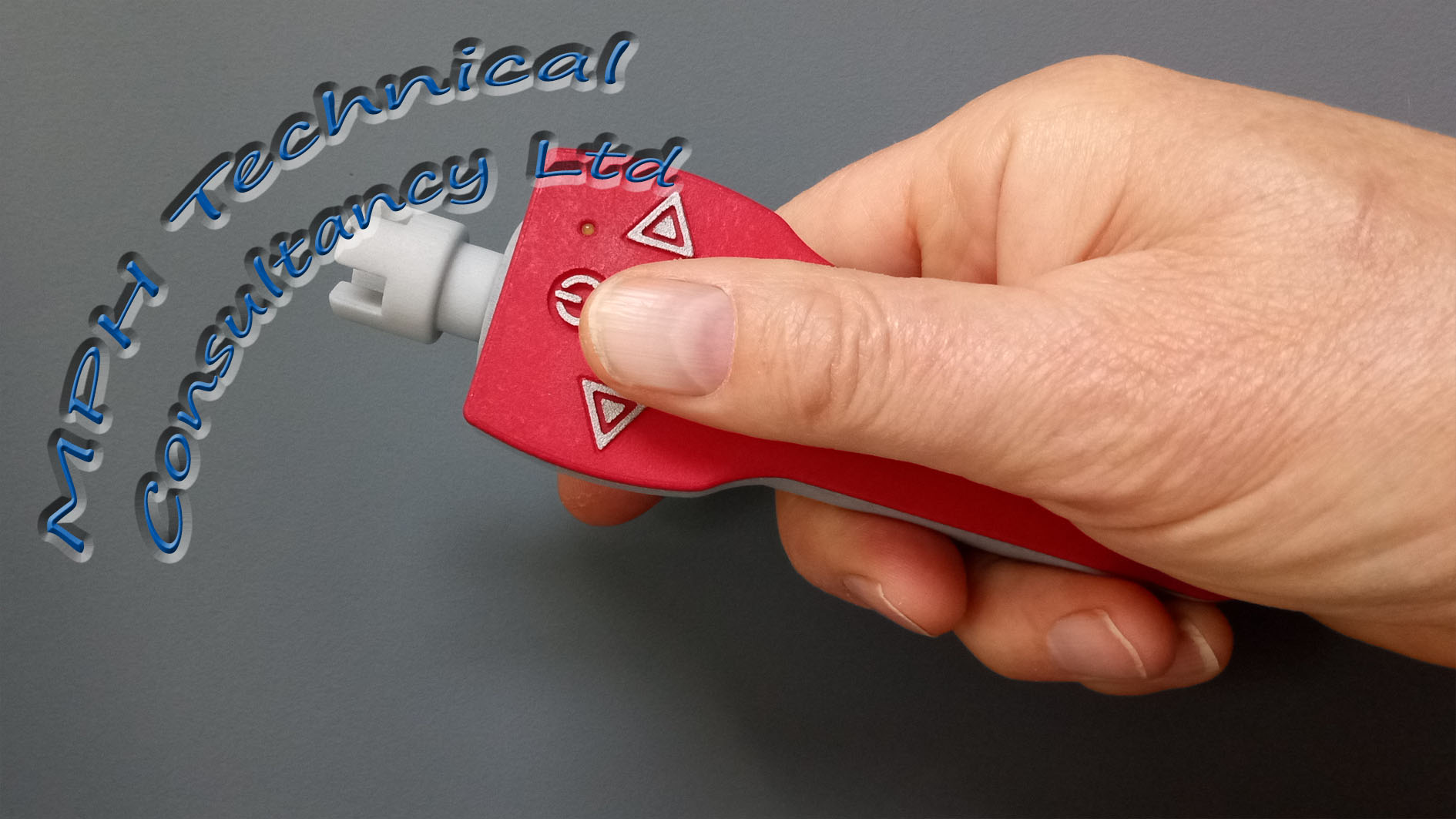
What you see here is a rechargeable, touch-controlled, handheld tool which is the outcome of that exercise. The result is a lightweight form with palm-fit, ease of use in mind and motor provided mechanical advantage.
We designed and refined the complete evaluation-ready product leveraging:
- 3D Mechanical design
- Electronic circuit and PCB design
- Microcontroller Firmware design
- Battery management function
- LED illumination
- Human touch interface
- Intelligent Motor Control
So how could this tool benefit you? Well, if you have a weakened wrist due to injury or perhaps arthritis it may help.
Take a look at the movie clip for a sample of things it could help with, it is designed to rotate/turn things for you. There are potentially many other human tasks
where it could assist, with a range of easy fit adaptors.
If you are interested in this product and how we may help you please contact us for more information, we would be very interested to hear from you. Click: Contact MPH Technical Consultancy
Personal Transport
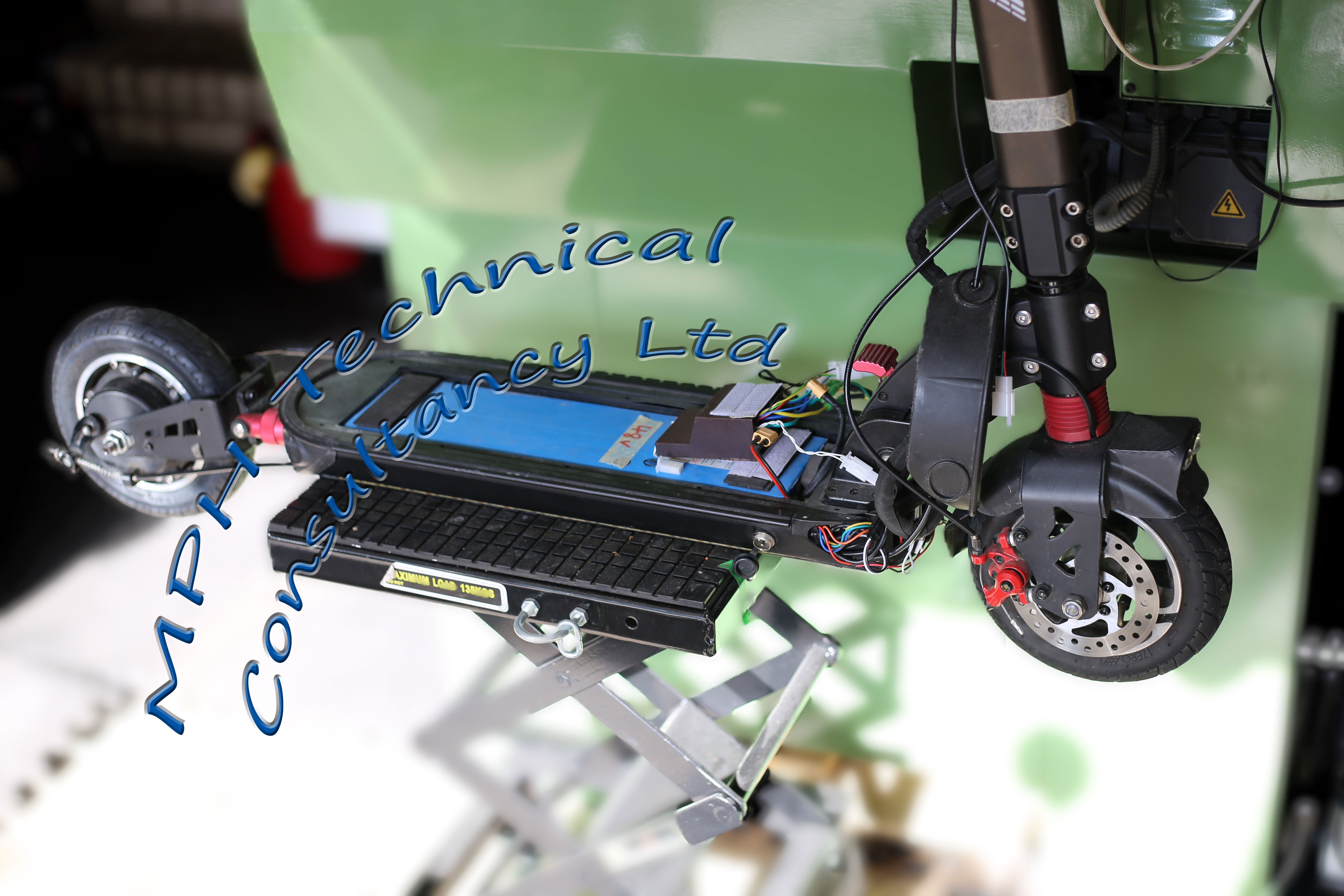
Electric bicycles or pedelecs and subsequently scooters (the one
shown in the photo) are what we worked on several years ago and each
time, when the market was new and evolving. At that time there were
motor related options around either using sensored or sensor-less
techniques and combining complementary control algorithms.
We then saw subseqent trends and the transition to higher battery
voltages and the move from front wheel hub motors to alternative
arrangements and the drive components integrated with the motor.
What can be observed here is the initial integration of our own motor controller design module
into the scooter electrical system for the purpose of evaluation
tests and development.
Subsequently, we introduced usability refinements and a choice of control algorithms that aligned with the application.
Mobility Dual Motor Control
The electric scooter is typically propelled by a single small form factor wheel-motor but for different applications
the diameter will vary depending on the torque and speed requirements.
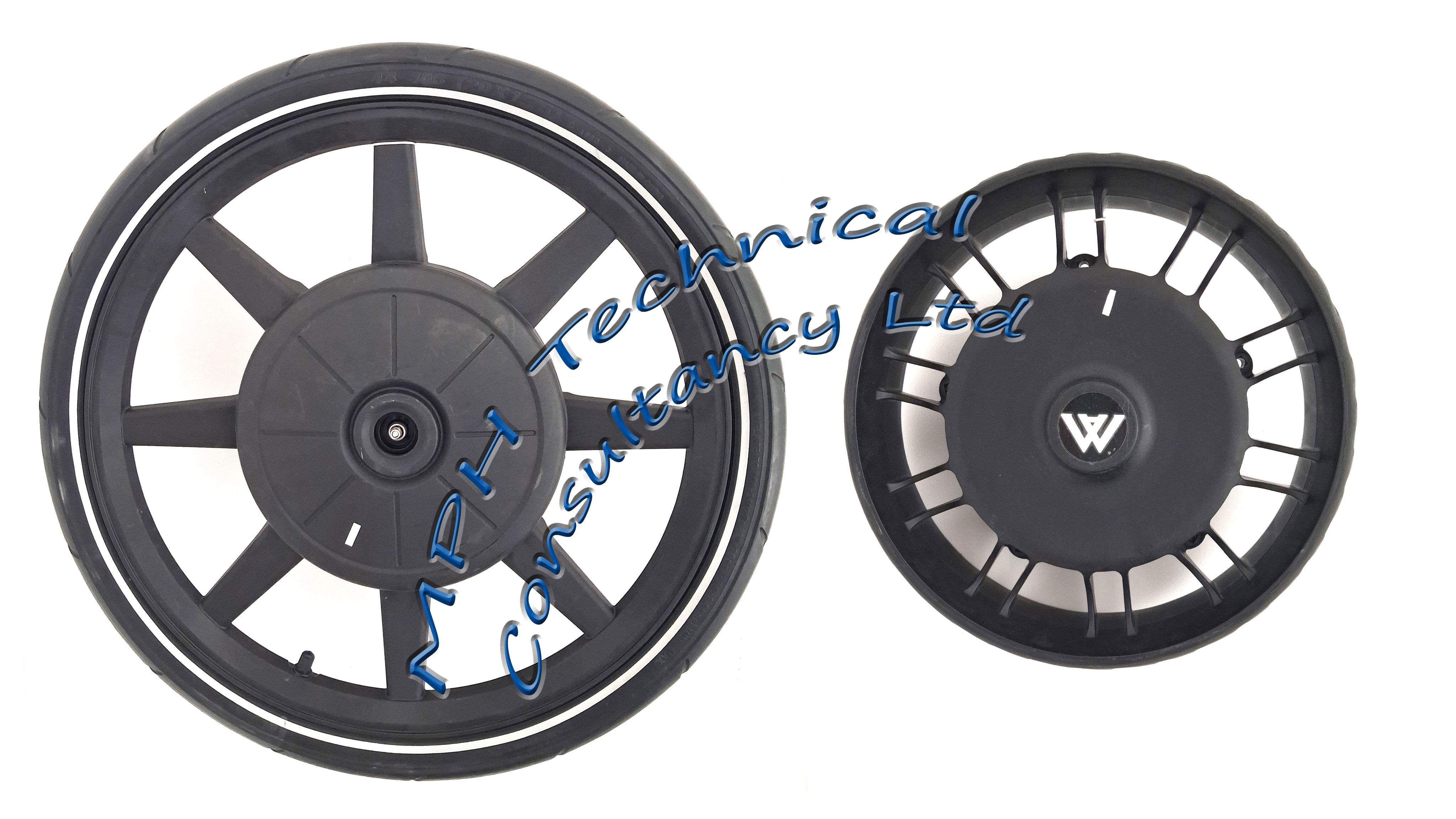
To the left are examples of larger wheel-motors that we have
used in dual motor applications, such as trolleys and trailers, in contrast with a bicycle's that is typically even larger.
They are also all classed as "Out-runners" where the motor stator is in the middle of the wheel and the rotor
is on the outer side.
It is important to select a motor that produces smooth torque coupled with a complementary control method for the best user experience.
Motor Control and MCU Peripherals Perspective
When the bandwidth of a microcontroller is challenged engineers
tend to reach for the compiler optimization features to help the
CPU. That can lead to a result before the next set of product features
are requested; at which point it is easy to make the case to move
up in device capability.
However, paying attention to signalling
between peripherals inside new generation devices can really help
with even better optimizations which would reclaim CPU bandwidth
plus!
This can be often done with subtle design configurations using
logic cells and specific sequencers which typically have the ability to map their inputs &
outputs to many pins and peripherals. This is key and leads to efficent design
and the resulting hardware configurations off load the CPU but also
lead to more determinism. Then the reconfigurability leads to soft
hardware! So, you have the best of both worlds with this flexibility
at your disposal.
